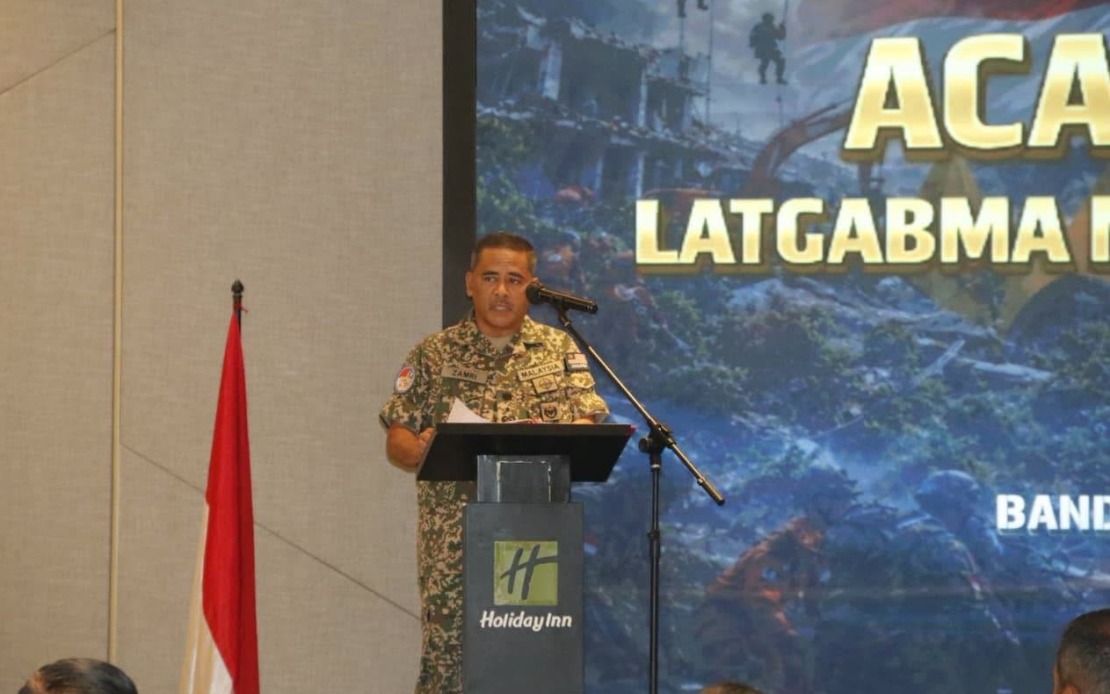
Malaysia and Indonesia have taken a significant step forward in their defence partnership through a major joint military exercise now underway in Indonesia's Lampung Province. The 13-day LATGABMA MALINDO DARSASA 12AB/2026 drill brings together 719 participants from both the Malaysian Armed Forces (MAF) and Indonesian National Armed Forces (TNI), representing a tangible demonstration of the strategic cooperation between Southeast Asia's two largest Muslim-majority nations. Conducted under the Joint Forces Headquarters at Al-Sultan Abdullah Camp in Kuala Lumpur, this exercise extends beyond routine military coordination to embody the deepening bilateral relationship that underpins regional stability.
The geographical selection of Bandar Lampung as the exercise's focal point reflects a deliberate strategic choice rather than arbitrary placement. Located at the convergence of three active tectonic plate belts, this province sits among Indonesia's most seismically volatile regions, a characteristic that directly informed the exercise design. The location allows both armed forces to train against realistic scenarios rooted in actual disaster experiences that have devastated southern Sumatra, including the devastating earthquakes and tsunamis that have struck the region. This grounding in genuine regional hazards elevates the training from theoretical exercises to practical preparedness drills with immediate applicability to both nations' civilian populations and security challenges.
According to Brigadier General Datuk Zamri Othman, who leads the 1st Infantry Brigade and heads the MAF's exercise planning contingent, the initiative transcends conventional military training protocols. Rather than serving as a perfunctory obligation between allied nations, the exercise crystallises the fraternal relationship and mutual strategic confidence that characterises modern Malaysia-Indonesia relations. The drill provides an opportunity for personnel from both forces to deepen their understanding of operational procedures, build personal relationships across institutional barriers, and develop coherent joint approaches to contemporary security threats that respect no national boundaries.
The contemporary security landscape motivating this cooperation has grown considerably more intricate than traditional interstate military concerns. Both Malaysia and Indonesia face overlapping vulnerabilities encompassing maritime crime syndicates that exploit the region's waters, organised smuggling networks that traverse porous borders, terrorism that periodically resurges in both nations, increasingly sophisticated cyber threats targeting critical infrastructure, and natural disasters that threaten millions of civilians. By conducting integrated exercises that address these non-traditional security challenges simultaneously, the two nations signal their recognition that effective responses demand coordinated capacity and shared operational doctrine rather than isolated national approaches.
The LATGABMA MALINDO DARSASA framework itself carries significant institutional history. Conducted triennially since 1984 through the Malaysia-Indonesia General Border Committee and the bilateral Joint Training Committee, the exercise rotates between the two nations' territories. The previous edition in 2023, held in Pekan, Pahang, concentrated on counter-terrorism scenarios. This rotation principle ensures both militaries develop capacity across diverse geographical and operational contexts while distributing training burdens and opportunities equitably. The established rhythm of the exercise demonstrates institutional commitment beyond ephemeral political goodwill, suggesting that defence cooperation rests on durable structural foundations rather than the temperament of individual leaders.
The current exercise architecture reveals a sophisticated multi-component design addressing contemporary complexity. The academic preparation phase, termed the Staff Exercise, equips participating commanders and planners with conceptual frameworks for addressing ten critical scenarios. These scenarios span the entire disaster management lifecycle: initial response during crisis onset, management of mass casualty situations, assessment and response to collapsed infrastructure, coordination of medical emergencies, orchestration of international humanitarian assistance, defence against cyber warfare, countering information operations, implementing mass population evacuation, restoring basic order during stabilisation, and transitioning from emergency to normalcy. This comprehensive scenario architecture reflects lessons learned from actual disasters and conflicts rather than hypothetical speculation.
The field training component introduces operational reality to these conceptual frameworks. Force Integration Training brings together MAF personnel, TNI counterparts, and Indonesian agencies including the National Search and Rescue Agency, Disaster Preparedness volunteer cadres, the Indonesian Red Cross, and regional disaster management bodies. Participants execute practical drills in technical skills including rope techniques, rappelling for rescue operations, emergency medical response, and establishment of functional field hospitals. This integrated approach ensures that military personnel understand how to coordinate with civilian emergency responders, a critical capacity that often determines disaster response effectiveness. The inclusion of non-military agencies reflects recognition that modern security challenges demand whole-of-government responses rather than military-centric solutions.
Beyond emergency response training, the exercise encompasses civic action programmes designed to deliver tangible benefits to affected communities. The Engineering Civil Action Programme involves repairing two uninhabitable houses in Kampung Sukamaju and constructing concrete road infrastructure in Kampung Keteguhan, demonstrating how military capacity serves development objectives. The Medical Civic Action Programme, conducted at community health centres, provides general health screenings, distributes free spectacles to residents, and conducts blood donation campaigns. These activities simultaneously improve community welfare and strengthen the relationship between military personnel and civilian populations, building social cohesion that undergirds national resilience during crises.
The cyber exercise component addresses a security dimension that barely existed during previous iterations of bilateral defence cooperation. Contemporary threats to critical infrastructure through digital means now rank among the most consequential security challenges facing both nations. Training encompasses reconnaissance techniques, information gathering methodologies, credential compromise attacks, man-in-the-middle attacks that intercept communications, spoofing attacks that impersonate legitimate systems, and feed manipulation that corrupts information streams. By training personnel to identify, prevent, and respond to such attacks, the exercise develops capacity to protect power grids, water systems, financial networks, and communications infrastructure that civilian populations depend upon daily.
The composition of participating personnel reflects the exercise's comprehensive scope. The 463 TNI personnel bring substantial numbers and institutional expertise from Indonesia's larger armed forces. The 150 MAF representatives ensure proportional Malaysian involvement while acknowledging Indonesia's greater population base. Indonesian National Police contribute specialised law enforcement perspectives, while 79 participants from various Indonesian agencies introduce diverse technical expertise. Representatives from Malaysia's National Disaster Management Agency ensure that lessons integrate into national civilian emergency management systems. This heterogeneous composition creates opportunities for cross-institutional learning that extends beyond traditional military-to-military channels.
From Malaysia's strategic perspective, this exercise demonstrates the continued salience of bilateral defence cooperation despite the multipolar regional environment and Malaysia's simultaneous partnerships with other powers. The exercise affirms that Malaysia and Indonesia, as neighbours sharing maritime boundaries and overlapping security interests, maintain strategic convergence on critical issues including maritime security, terrorism prevention, and disaster management. It signals to other regional powers that Malaysia and Indonesia have achieved sufficient maturity in their relationship to conduct sophisticated joint military operations without external mediation or sponsorship. This autonomous capacity strengthens both nations' strategic autonomy in the evolving Indo-Pacific security environment.
The exercise also carries implications for Malaysia's participation in broader regional security architecture. As both nations navigate relationships with China, the United States, India, and other powers with interests in Southeast Asia, demonstrating robust bilateral capacity becomes strategically valuable. The drill exemplifies how Malaysia can pursue security partnerships that are genuinely bilateral rather than merely aligned with external powers' strategic preferences. This capacity for independent cooperation enhances Malaysia's leverage in great power diplomacy while demonstrating the region's capacity for self-reliant security arrangements.
Looking forward, the LATGABMA MALINDO DARSASA exercise establishes a template for addressing security challenges that will only intensify. Climate change will increase disaster frequency and severity across both nations, cyber threats will proliferate as digitalisation expands, maritime pressures will mount as shipping volumes and resource competition increase, and transnational crime will evolve in response to enforcement efforts. By institutionalising regular joint exercises that address these interconnected challenges, Malaysia and Indonesia create enduring mechanisms for adaptation and coordinated response. The exercise ultimately represents not merely military cooperation but commitment to regional stability and prosperity through shared resilience.