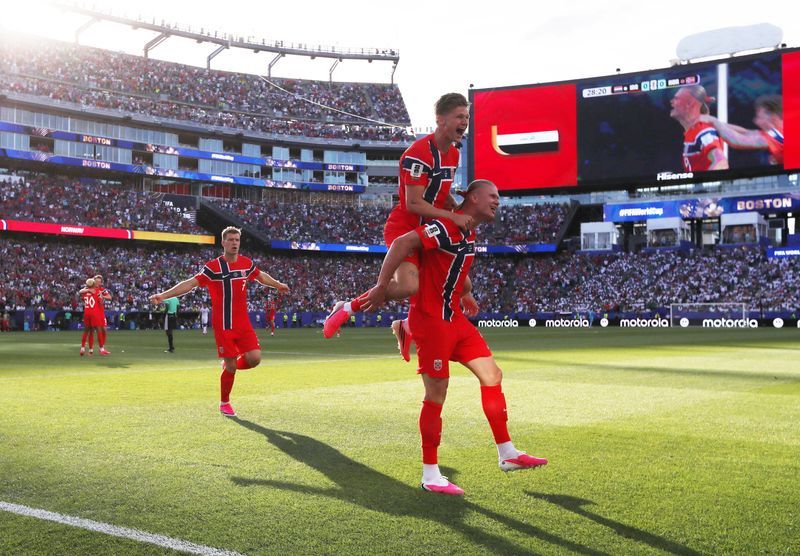
Erling Haaland wasted no time making an impact at the World Cup, delivering a masterclass that underscored why he remains one of football's most lethal finishers. The Norwegian striker's two goals in the first half steered his nation to a dominant 4-1 triumph over Iraq on Tuesday, providing an emphatic statement in his maiden appearance at the tournament. For a country that had endured a 28-year absence from the World Cup since 1998, Haaland's clinical display offered both immediate validation of their qualification and a tantalising preview of their potential in the competition ahead.
The 23-year-old's brace represents a remarkable feat across elite football's most prestigious stages. Having already announced himself with crucial goals on his debuts in the German Bundesliga, English Premier League, and UEFA Champions League, Haaland has now extended that streak to include the World Cup finals. This consistency in high-pressure situations—finding the net immediately upon arrival in new competitions—speaks to his exceptional poise and predatory instinct in the penalty area. Few strikers in the modern game possess such an uncanny ability to hit the ground running at the sport's grandest occasions.
Haaland's opening goal exemplified the poacher's art, arriving after David Moller Wolfe delivered a precise cross to the far post. The second displayed different qualities—a pressing intensity that forced Iraq's defenders into an error before the striker capitalised on a weak goalkeeper's clearance. Together, they illustrated why coach Stale Solbakken's tactical approach centres squarely on creating opportunities for his talismanic forward. The philosophy is straightforward: position Haaland effectively and let his predatory instincts do the rest.
Yet beneath the emphatic scoreline lay concerning elements of Norway's performance that cannot be overlooked. Despite the commanding 4-1 margin, the Scandinavian outfit demonstrated inconsistency and careless possession, with numerous misplaced passes and moments where they failed to establish dominance. Captain Martin Odegaard, Norway's creative fulcrum in midfield, was surprisingly subdued throughout much of the encounter, unable to impose his usual influence on proceedings. This suggests that while Haaland's brilliance papered over cracks, deeper tactical work may be necessary for matches against more formidable opponents.
Defensive vulnerabilities also surfaced when Iraq capitalised on momentary lapses in concentration. The Iraqis' equalising goal from Aymen Hussein resulted from poor positioning, a reminder that even in a comfortable victory, lapses against stronger teams could prove costly. Stale Solbakken's defensive organisation will require fine-tuning, particularly given the quality of opponents awaiting in the group phase. France, whom the Norwegians must face, demonstrated far superior attacking prowess in their 3-1 dismantling of Senegal, and clinical finishing from the attacking third may prove insufficient without defensive solidity.
The victory propels Norway to the top of their group with three points, ahead of France on goal difference following the latter's successful opener. This position is precarious, however, and dependent on results in subsequent matches. For a nation preparing to face some of football's elite sides, starting positively matters psychologically, yet the margins for error are razor-thin. The return to the World Cup stage after 28 years carries immense expectations from the Norwegian public and media, creating additional pressure that only intensified following the convincing opening win.
Prime Minister Jonas Gahr Stoere's pre-match observation that teams, rather than individuals, win matches proved partially applicable here. While Haaland undoubtedly carried Norway through stretches where their collective performance wavered, the team's ability to score four goals provided sufficient attacking output to overcome their organisational shortcomings. This dynamic—leaning heavily on individual brilliance rather than cohesive team play—raises questions about sustainability. Against defensively organised opponents who might limit Haaland's clear-cut opportunities, Norway's depth of alternatives in attacking positions becomes crucial.
Haaland's characteristic reticence with media gathered in the aftermath reflected his preference for allowing goals to communicate rather than words. The striker rarely elaborates on performances or offers expansive commentary, a departure from many modern footballers' social media-dominated personas. His understated demeanour belies an intensity and focus that emerges only when the whistle blows. Post-match, his brief observations acknowledged fortune in the victory while emphasising the gulf between their display and the level required for further advancement, a realistic assessment that suggests neither complacency nor overconfidence will infiltrate the Norwegian camp.
For Malaysian and regional fans observing the tournament, Haaland's performance offers insights into what separates elite strikers operating at the highest echelon. His movement, positioning sense, and ruthless finishing provide a template that aspiring Asian attackers study and emulate. The manner in which he pressed Iraqi defenders into mistakes—forcing the turnover that led to his second goal—demonstrates that modern centre-forwards require more than simple poaching instincts; they must contribute to defensive transitions and pressing intensity. Such attributes elevate sides from ordinary to competitive at the elite level.
Norway's challenge now involves building upon this encouraging foundation whilst addressing the mechanical and organisational issues that emerged. Haaland's arrival as a World Cup threat is confirmed, but whether he receives sufficient support from teammates adapting to the tournament's demands remains an open question. The journey from qualifying for the first World Cup in nearly three decades to competing meaningfully in the latter stages demands consistency beyond individual performance, a lesson Solbakken's side will quickly learn as they progress through their group.