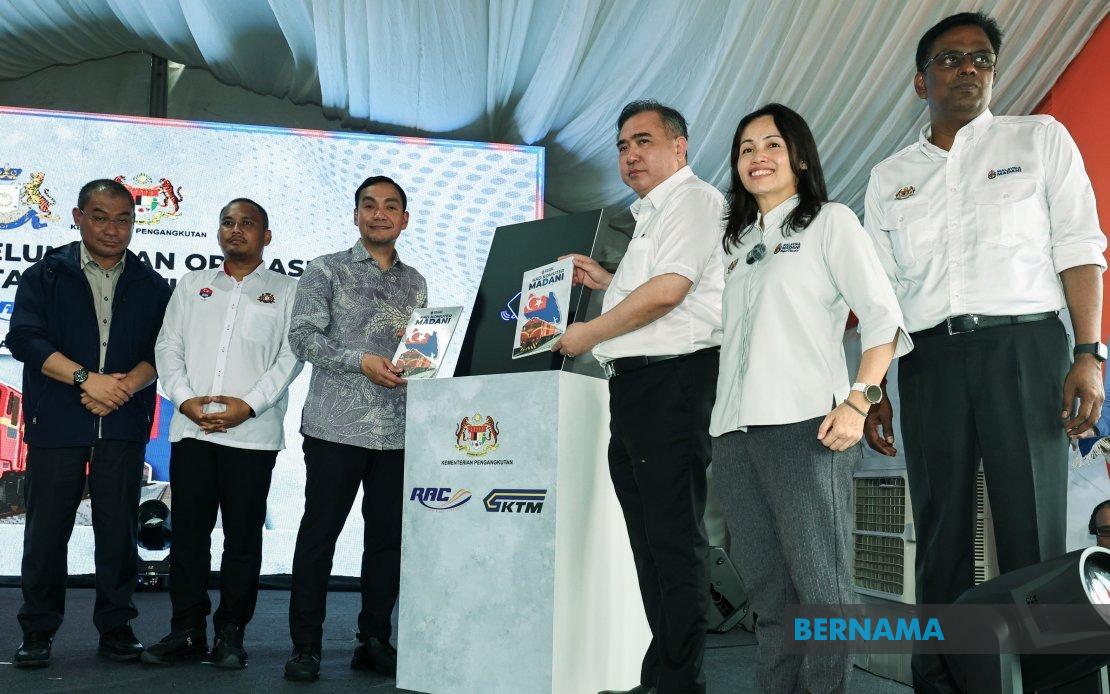
Johor Menteri Besar Datuk Seri Onn Hafiz Ghazi has underscored the strategic importance of the Elevated Autonomous Rapid Transit (E-ART) project in preventing gridlock across Johor Bahru once the Johor Bahru-Singapore Rapid Transit System (RTS) Link commences operations next year. Speaking at the launch of the Southern Shuttle train service at KTM Kulai Station, Onn Hafiz framed the autonomous transit system as an indispensable long-term solution to absorb the exponential increase in passenger flows that will strain existing road infrastructure when the cross-border link becomes operational.
The Menteri Besar's comments underscore a critical reality facing Johor Bahru's urban planners: the state capital's existing transportation network, developed over decades for conventional traffic patterns, will face unprecedented demand once the RTS Link opens its corridors to commuters. With an estimated 1.8 million residents—a population comparable to Penang—Johor Bahru already grapples with congestion during peak hours. The anticipated surge in daily passenger volumes from Singapore and within the conurbation itself will amplify these pressures unless complementary transit systems are deployed swiftly.
Onn Hafiz acknowledged that the interim strategies currently being rolled out, including expanded Park & Ride facilities and intelligent traffic control systems centred on JB Sentral, provide only temporary congestion relief. These measures, he explained, represent necessary bridge solutions while the E-ART project—the structural transformation required to permanently redirect vehicle flows—remains in development. The distinction matters: short-term interventions buy time for planners, but without the autonomous rapid transit network, the city risks reverting to severe bottlenecks as soon as the RTS Link reaches full capacity.
The positioning of E-ART as a federal priority reflects broader concerns about Johor Bahru's role as Malaysia's primary international gateway. The state capital functions as a crucial junction for cross-border commerce, tourism, and workforce mobility. Any protracted traffic crisis would ripple across the region's supply chains and economic productivity, affecting not only Johor but also downstream sectors across Malaysia and Singapore. By emphasising federal government commitment to expediting the project, Onn Hafiz has signalled that infrastructure investment in the state carries national economic implications.
Transport Minister Anthony Loke and Deputy Communications Minister Teo Nie Ching, who represents Kulai, were present at the Southern Shuttle launch, lending visible federal backing to the state's transportation agenda. This ministerial attendance suggests alignment between state and federal priorities on addressing the RTS Link's traffic consequences. However, the visibility of federal support at ceremonial events must eventually translate into accelerated project timelines, funding allocations, and regulatory clearances for the E-ART initiative to avoid becoming an unfulfilled promise.
The E-ART concept itself represents a modernisation leap for Malaysian urban mobility. An elevated autonomous system would bypass surface-level congestion, operate on fixed routes with high frequency, and integrate seamlessly with existing transit networks. For Johor Bahru's residents and cross-border commuters, such a system promises reliable travel times and reduced exposure to weather and traffic variability. From a city planning perspective, autonomous rapid transit enables higher-density development patterns along corridors, potentially reshaping Johor Bahru's spatial structure over the next decade.
Yet uncertainties surround the E-ART's implementation timeline and technical specifications. The project has not yet commenced major construction, and autonomous rapid transit systems globally remain relatively nascent outside pilot programmes. Cost overruns, technical delays, and scope adjustments are common in comparable infrastructure initiatives. Johor Bahru cannot afford lengthy deferrals; the RTS Link's opening will occur on a set schedule, meaning the window for deploying complementary transit capacity is narrowing.
Onn Hafiz's characterisation of federal intervention in E-ART as a gesture that will resonate with constituents reflects the political dimensions of infrastructure delivery. In Malaysia's federal structure, major transport projects often become barometers of state-federal cooperation and central government responsiveness to regional needs. A successfully executed E-ART project would symbolise meaningful federal investment in Johor, whereas delays or abandonment would fuel perceptions of neglect. This political economy shapes not only the technical planning but also the priority accorded to the initiative within national capital budgets.
The broader context extends to Southeast Asia's rapid urbanisation and regional integration. The RTS Link exemplifies transnational connectivity—a direct urban rail bridge between Malaysia and Singapore. As such corridors proliferate across the region, the supporting infrastructure that manages these flows becomes increasingly critical. Johor Bahru's experience with the RTS Link and its response through projects like E-ART will likely inform how other Malaysian and Southeast Asian cities prepare for enhanced cross-border mobility.
For commuters and businesses already planning for RTS Link usage, the uncertainty around E-ART completion presents both opportunity and risk. Those who can adopt flexible work arrangements or stagger their travel times may adapt more readily. However, sectors dependent on predictable logistics and workforce movement—manufacturing, services, retail—face genuine exposure to congestion disruptions if the autonomous transit system remains incomplete when cross-border volumes spike. This creates pressure on project stakeholders to maintain momentum and accelerate delivery schedules.
Onn Hafiz's public emphasis on E-ART also signals that Johor's leadership recognises the limits of conventional traffic management. Expanding road capacity through additional lanes or intersections would be costlier, require extensive land acquisition, and offer diminishing returns in congested urban cores. By contrast, E-ART represents a paradigm shift toward vertical, high-capacity transit infrastructure that preserves urban space and offers superior passenger experience. Embracing this shift demonstrates recognition of evolving urban mobility best practices.
Looking ahead, the convergence of the RTS Link's opening and E-ART's deployment status will largely determine whether Johor Bahru experiences seamless integration of transnational mobility or confronts a transition period marked by congestion and frustrated commuters. The success of this infrastructure bundle will also signal to investors and residents whether Johor Bahru can evolve into a genuinely world-class urban centre or whether it will struggle with the strains of rapid growth. Federal determination and swift execution of the E-ART project, as Onn Hafiz emphasised, are not mere administrative tasks but essential prerequisites for the state's continued development and the region's economic resilience.