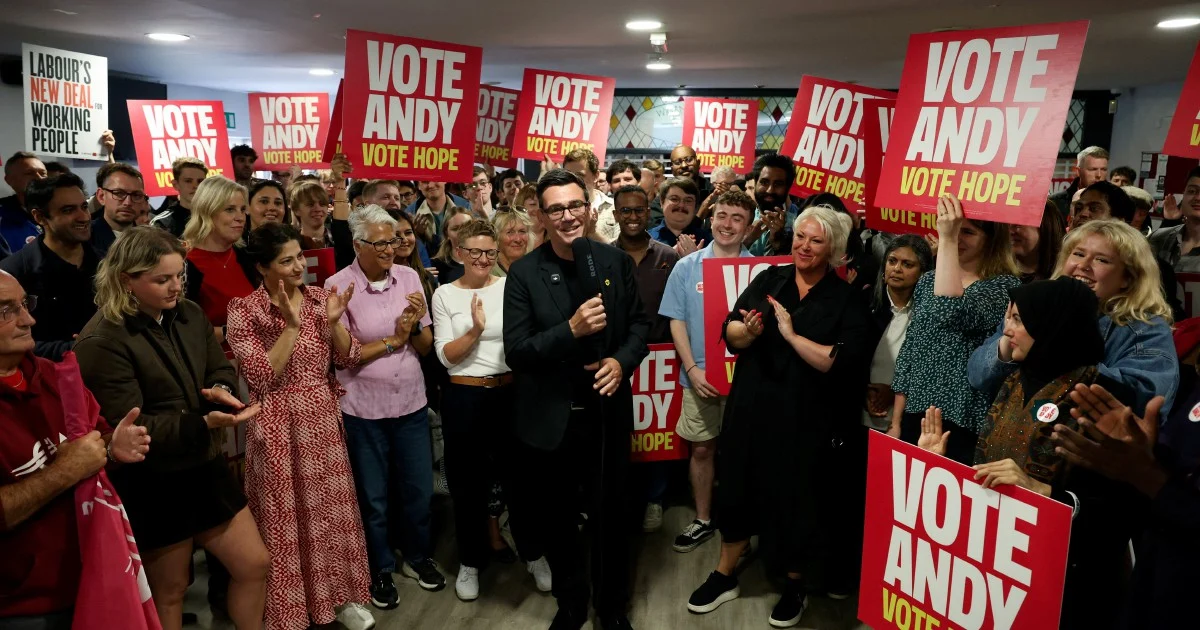
Labour politician Andy Burnham appears increasingly positioned to capture the Makerfield constituency in Thursday's election, a critical stepping stone toward his potential challenge to Prime Minister Keir Starmer's leadership. Yet analysis of the political landscape suggests his victory may owe as much to infighting between populist conservative parties as to his own standing with voters, a dynamic that reflects deeper fractures within Britain's centre-right electorate.
The Makerfield seat in northwest England has traditionally been a bellwether for Labour's electoral fortunes. Burnham's ability to secure this constituency would represent a symbolic consolidation of power within his party's traditional heartland, establishing the credibility necessary for any internal bid to unseat a sitting Prime Minister. Such challenges are rare in British politics, requiring not merely party support but also a demonstrated capacity to win critical seats and maintain grassroots momentum.
However, the peculiar advantage Burnham currently enjoys stems not from voter enthusiasm for his leadership vision but rather from a strategic division among his opponents. The Conservative Party, long the traditional party of government, and Reform UK, a newer populist movement, are cannibalising each other's support in constituencies across the country. Neither party has successfully consolidated the right-wing vote, leaving space for Labour to advance without necessarily winning over significant numbers of centre-right voters.
This fragmentation reflects a broader phenomenon affecting British politics. Reform UK, led by figures who have capitalised on anti-establishment sentiment, has attracted voters frustrated with traditional Conservative governance. Simultaneously, the Conservative Party remains weakened after years of internal instability, leadership changes, and policy inconsistency. Rather than coalescing around a single opposition force, voters on the right have splintered their backing between these competing visions, effectively handing an advantage to Labour in numerous marginal constituencies.
For Malaysian observers, this scenario offers instructive parallels to coalition politics in Southeast Asia, where fragmented opposition movements frequently enable dominant parties to consolidate power without necessarily commanding majority support. The Makerfield result, whatever it proves to be, will illuminate how effective such vote-splitting dynamics are at the national level and whether they constitute a sustainable advantage or merely a temporary circumstantial benefit.
Burnham himself brings considerable credentials to any leadership challenge. His background as Mayor of Greater Manchester provided executive experience and public visibility, positioning him as a figure of substance within Labour's ranks. Yet the question of whether he can translate local and regional prominence into a credible national challenge remains unresolved. Many potential challenges to sitting premiers fail because the challenger cannot demonstrate sufficient party support or public appeal to overcome the incumbent's structural advantages.
The timing of any such challenge would depend on multiple factors, including Labour's performance in Thursday's election, the party's internal power dynamics, and Starmer's trajectory as Prime Minister. Should Labour experience significant electoral success, internal challenges would become virtually impossible; should results disappoint, pressures for leadership change might accelerate. The months following the election will prove revealing about the actual strength of Burnham's position versus the circumstantial advantages he currently enjoys.
The broader significance of this dynamic extends beyond individual political fortunes. British voters frustrated with traditional parties have been searching for alternative political homes, creating the conditions for newer movements like Reform UK to emerge. Simultaneously, long-established parties struggle to adapt to shifting electoral geography and changing voter priorities. The fragmentation visible in Makerfield is replicated across much of the country, suggesting that British politics may be entering a period of sustained volatility and realignment rather than returning to stable two-party competition.
For regional observers, the British situation underscores how populist movements and anti-establishment sentiment can reshape electoral mathematics without necessarily producing clear alternative governments or coherent policy platforms. Malaysia and other Southeast Asian democracies have witnessed similar phenomena, where protest votes and opposition fragmentation create unpredictable outcomes without establishing stable governance alternatives.
Burnham's immediate focus remains winning Makerfield and consolidating Labour's position within his region. Whether this translates into a serious challenge to Starmer, or remains merely a demonstration of competent regional leadership within a dominant national party structure, will depend on events far beyond Thursday's election. What remains clear is that in contemporary British politics, as in many democracies worldwide, the fracturing of traditional political structures creates both opportunities and instability, often determining outcomes as profoundly as voters' affirmative choices.