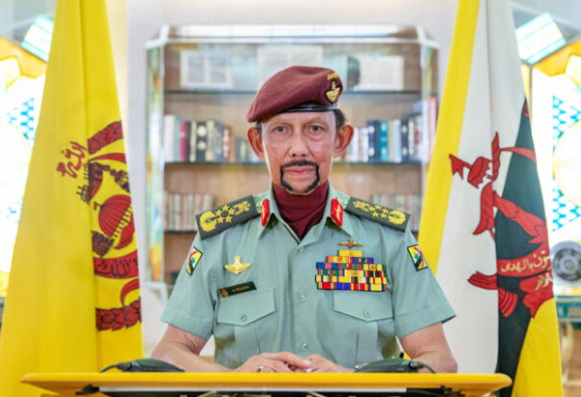
Brunei's Sultan Hassanal Bolkiah has used the arrival of the Islamic New Year 1448 Hijrah as an occasion to rally his nation around the dual imperatives of material advancement and spiritual enrichment, presenting a vision of progress rooted in religious devotion and collective responsibility. In his address marking the occasion, the Sultan framed the new year not merely as a temporal milestone but as a deliberate moment for citizens and residents to reaffirm their commitment to the nation's ongoing development across multiple fronts.
The monarch articulated a comprehensive understanding of national progress that extends beyond conventional economic metrics. His framing divides development into two interconnected spheres: the material realm, encompassing economic growth and physical infrastructure, and the spiritual dimension, which includes knowledge acquisition, educational advancement and dakwah—the Islamic concept of inviting others towards religious understanding. This duality reflects a governing philosophy that rejects false dichotomies between secular development and religious values, instead presenting them as complementary forces that reinforce one another.
Central to the Sultan's message is the notion that the arrival of a new year should function as a catalyst for renewed resolution rather than a mere calendar turning point that invites procrastination. The timing of his remarks suggests an attempt to harness the psychological momentum of a fresh beginning, urging the population to view 1448 Hijrah as a deliberate prompt to intensify efforts already underway rather than to initiate new undertakings from scratch. This emphasis on continuity and sustained commitment speaks to governance challenges that typically require persistence beyond short-term enthusiasm.
The Sultan's acknowledgement of global turbulence provides important context for his domestic message. By noting that the contemporary world grapples with persistent conflicts and challenges that generate widespread suffering irrespective of which parties are involved, he establishes a contrast between Brunei's relative insulation from such instability and the protective circumstances that have enabled the nation to thrive. This framing implicitly encourages citizens to recognise and appreciate the conditions of peace and stability that they inhabit—conditions that should not be taken for granted.
Brunei's freedom from major natural disasters, which the Sultan identified as a blessing worthy of gratitude, represents a geographic advantage that many Southeast Asian nations cannot claim. However, the Sultan attributes this favourable situation not to luck alone but to spiritual factors: he credits the nation's peace and stability to collective prayers, remembrance of God and engagement with Islamic scripture. This theological interpretation transforms what might be viewed as geographical fortune into a responsibility to maintain the spiritual practices that, in his understanding, have sustained national wellbeing.
Yet the Sultan's address takes a notably serious turn when he identifies crime as a persistent threat demanding unified response. His specific attention to drug-related offences, theft and associated criminal activity signals concern that such breaches of law and social order undermine not only daily security but also the nation's international reputation and standing. By characterising these acts as condemned by religious teaching, the Sultan attempts to mobilise Islamic values as a cultural resource for crime prevention, rather than relying solely on law enforcement mechanisms.
The Sultan's prescription for addressing these challenges distributes responsibility across multiple institutional actors. Security agencies, religious authorities, and educational institutions each have roles to play in what he presents as an interconnected strategy. For the religious sector in particular, he emphasises the necessity of strengthening both formal religious education and grassroots dakwah efforts designed to build societal awareness and foster rejection of drug use and criminality. This approach recognises that institutional enforcement alone proves insufficient without concurrent efforts to shape cultural attitudes and individual choices through education and spiritual persuasion.
The Sultan's invocation of prayer and divine protection as essential components of the nation's defence strategy reveals the deeply religious framing through which he interprets national security and stability. His call for Muslims to intensify their supplications for safety and protection, coupled with his confidence that divine blessing will sustain the nation, integrates spiritual practice directly into the apparatus of governance. For Malaysian readers familiar with similar religious rhetoric in their own national context, this integration of faith and statecraft may resonate as reflecting broader Southeast Asian patterns of Islamic-inflected governance.
Crucially, the Sultan frames crime prevention and national security as shared responsibilities that transcend hierarchical distinctions between rulers and subjects, or between state institutions and civil society. His emphasis on collective vigilance, combined with repeated injunctions against negligence and complacency, suggests that he views the maintenance of Brunei's stability as requiring constant, distributed effort rather than relying on authorities alone. This message carries implicit warnings about the consequences of public indifference or passive acceptance of criminal activity.
The Sultan's closing extension of new year wishes to all citizens and residents, including non-nationals, demonstrates an attempt to frame the message of national unity and shared purpose as encompassing the entire population inhabiting Brunei's territory. This inclusive gesture acknowledges the presence of diverse communities while maintaining the explicitly Islamic framework through which the Sultan articulates national vision and aspiration.
For Malaysia and other Southeast Asian nations navigating similar challenges of balancing development with security, managing religious identity within pluralistic contexts and mobilising collective effort toward shared goals, the Sultan's address offers instructive parallels. His approach demonstrates how religious authority can be deployed to address contemporary governance challenges, though the effectiveness of such strategies depends ultimately on whether rhetoric translates into sustained action and measurable outcomes in crime reduction and institutional performance.