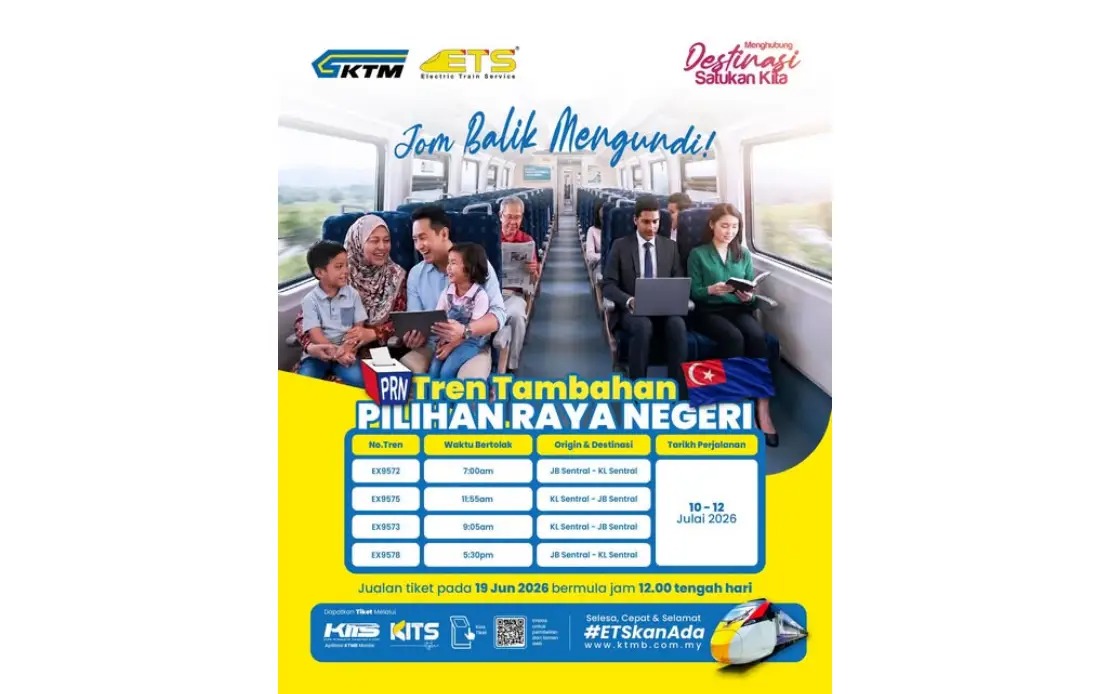
Keretapi Tanah Melayu Berhad (KTMB), the nation's premier rail operator, has rolled out enhanced Electric Train Service (ETS) capacity on its southern routes ahead of the Johor state election, recognising the anticipated surge in passenger demand as Malaysians move to vote. The supplementary services will run during the three-day voting window between July 10 and 12, giving eligible electors from across the country a practical transport option to return home for what is shaping up to be a closely watched regional contest.
The state election in Johor carries particular significance within Malaysian politics given the economic importance and demographic scale of the southern region. As one of the nation's most developed and populous states, electoral outcomes here often reverberate across federal political calculations. The timing of this announcement—roughly three weeks before polling day—reflects KTMB's experience managing transport flows during major electoral events and its operational readiness to support civic participation.
Ticket purchasing opens at noon on the day of the announcement, with KTMB deploying a diversified sales strategy recognising that modern Malaysian travellers expect multiple booking channels. The KTMB Mobile app represents the primary digital avenue, though the company is simultaneously offering access through the KITS Style platform, its official online portal at online.ktmb.com.my, and traditional ticket kiosks stationed across major stations. This multi-channel approach ensures accessibility regardless of technological comfort levels or internet connectivity, particularly important given that voters may hail from rural constituencies with variable digital infrastructure.
The announcement arrives in the immediate aftermath of the State Legislative Assembly's dissolution on June 1, a procedural step mandated by constitutional requirements that formally initiates the electoral calendar. The Election Commission subsequently fixed July 11 as polling day, establishing the temporal parameters within which KTMB now operates. For the rail operator, this creates a logistical window requiring both supply-side expansion and demand forecasting, as underestimating passenger numbers risks overcrowding and reputational damage, whilst overestimating generates unnecessary operational costs.
From a practical standpoint, KTMB's willingness to augment ETS services demonstrates how election logistics intersect with everyday transport infrastructure. The ETS network's northern terminus in Kuala Lumpur and southern reach into Johor means the operator occupies a critical role in facilitating internal migration during polling periods. Given Malaysian work patterns, where significant portions of the electorate reside in Klang Valley employment centres whilst maintaining voter registration in home constituencies, these rail services become essential enabling mechanisms for democratic participation.
The southern corridor's importance within Malaysia's transport ecosystem cannot be understated. Comprising the main spine connecting the Klang Valley to Johor Bahru and beyond, this route experiences consistent baseline demand from commuters, business travellers, and leisure passengers. During election cycles, this traffic intensifies as voters embark on sometimes lengthy journeys to reach their designated polling centres. KTMB's historical experience suggests that surge capacity becomes necessary, particularly on the eve and eve of polling day itself, when traveller concentration peaks.
The operational implications for KTMB extend beyond simple timetable adjustments. Additional train services require coordinated scheduling across track infrastructure, staff rostering, maintenance protocols, and crew management. The rail operator must synchronise these enhancements with existing commercial and commuter services whilst maintaining safety standards and punctuality expectations. This coordination intensity underscores why such announcements emerge weeks ahead of polling, allowing time for comprehensive planning.
For Malaysian voters, this initiative represents a tangible facilitation mechanism that reduces practical barriers to electoral participation. By providing additional capacity and convenient booking platforms, KTMB removes one potential obstacle to voting, particularly for those without personal transport or residing at distances making private vehicles impractical. The accessibility dimension carries democratic significance, as participation barriers—even logistical ones—disproportionately affect certain demographic segments.
The decision also reflects broader patterns whereby public institutions calibrate service levels around major national events. Whether elections, religious observances, or school holidays, Malaysian transport providers routinely expand capacity to manage predictable surges. This institutional responsiveness has become embedded within expectations surrounding major civic occasions, with KTMB's proactive approach aligning with voter convenience and government objectives of maximising participation.
Regional implications merit consideration as well. Johor's electoral significance extends beyond state boundaries, with outcomes potentially influencing broader coalition calculations at federal level. Enhanced transport connectivity supporting participation thus becomes instrumentally important, as higher turnout—particularly when geographically diverse—produces results perceived as carrying stronger legitimacy mandates for governing coalitions. KTMB's facilitation therefore contributes modestly to the overall integrity and representativeness of the electoral process.
%22%2F%3E%3C%2Fpattern%3E%3C%2Fdefs%3E%3Crect%20width%3D%22100%25%22%20height%3D%22100%25%22%20fill%3D%22url(%23ph5i5e3g)%22%2F%3E%3Crect%20width%3D%22100%25%22%20height%3D%22100%25%22%20fill%3D%22url(%23ph5i5e3p)%22%2F%3E%3Ctext%20x%3D%2250%25%22%20y%3D%2250%25%22%20text-anchor%3D%22middle%22%20dominant-baseline%3D%22central%22%20fill%3D%22rgba(255%2C255%2C255%2C0.95)%22%20font-family%3D%22Georgia%2C%20'Times%20New%20Roman'%2C%20serif%22%20font-weight%3D%22700%22%20font-size%3D%22272%22%20letter-spacing%3D%22-0.02em%22%3EAnwar%3C%2Ftext%3E%3C%2Fsvg%3E)
%22%2F%3E%3C%2Fpattern%3E%3C%2Fdefs%3E%3Crect%20width%3D%22100%25%22%20height%3D%22100%25%22%20fill%3D%22url(%23ph2oh7yg)%22%2F%3E%3Crect%20width%3D%22100%25%22%20height%3D%22100%25%22%20fill%3D%22url(%23ph2oh7yp)%22%2F%3E%3Ctext%20x%3D%2250%25%22%20y%3D%2250%25%22%20text-anchor%3D%22middle%22%20dominant-baseline%3D%22central%22%20fill%3D%22rgba(255%2C255%2C255%2C0.95)%22%20font-family%3D%22Georgia%2C%20'Times%20New%20Roman'%2C%20serif%22%20font-weight%3D%22700%22%20font-size%3D%22226%22%20letter-spacing%3D%22-0.02em%22%3EPolice%3C%2Ftext%3E%3C%2Fsvg%3E)