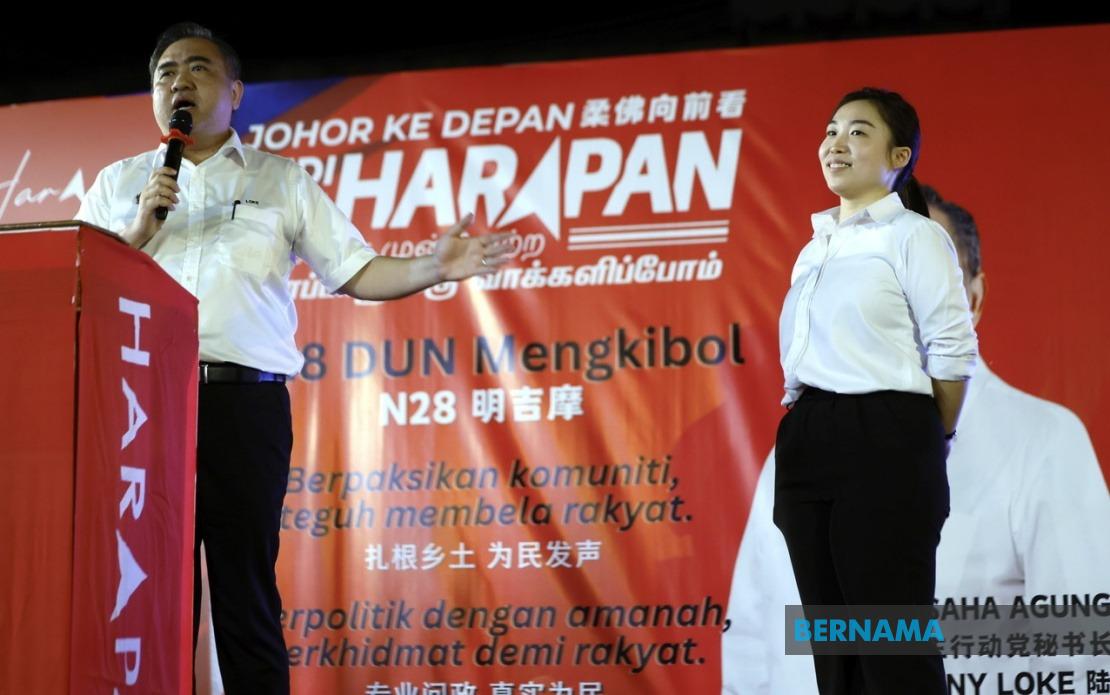
The DAP has tapped 33-year-old lawyer Chu Poh Yee to contest the Mengkibol state assembly seat in the forthcoming Johor election, signalling a strategic shift in the party's approach to candidate selection and succession planning across the state. The announcement came during a ceremony in Kluang on Monday evening, where party secretary-general Anthony Loke outlined the reasoning behind the decision and provided glimpses into the broader candidacy framework for the state polls.
Chu's nomination represents a deliberate attempt to inject fresh energy into the Mengkibol constituency, which has been represented by Chew Chong Sin for the past two terms. Rather than retiring the incumbent entirely, the DAP has identified Chew as a prospective parliamentary candidate for the Labis federal seat. This move anticipates the expected vacancy in Labis, where current Member of Parliament Pang Hok Liong has already signalled he will not contest in the next general election. The reshuffling demonstrates how opposition coalitions strategically reposition sitting state assemblymen toward higher political office when parliamentary opportunities emerge.
According to Loke, the party leadership reached unanimous consensus on Chu's candidacy after careful deliberation. The selection process emphasised her demonstrated capability in providing legal assistance to residents and her track record of supporting local elected representatives with legal aid matters. These credentials suggest the DAP believes Mengkibol constituents value practical, hands-on representation addressing legal and administrative challenges affecting ordinary families. Chu's background in law positions her to continue delivering such services, maintaining continuity in the type of grassroots support Chew has reportedly provided.
Beyond her professional qualifications, party officials highlighted Chu's educational achievements and multilingual abilities as key assets. In a diverse constituency like Mengkibol, where residents speak various local languages alongside Malay and English, linguistic proficiency carries tangible electoral weight. More significantly, Loke stressed that Chu maintains strong personal connections within the Mengkibol area, addressing a potential vulnerability when replacing an incumbent. Building genuine community ties typically requires sustained presence and engagement—factors that candidates cannot simply claim without substantiation. The emphasis on her existing roots suggests the DAP has conducted adequate groundwork to verify this claim.
The nomination also reflects the DAP's broader institutional commitment to elevating more women into electoral politics. By placing Chu in a seat the party currently holds, the DAP reduces the risk typically associated with fielding women candidates in marginal or highly contested constituencies, where gender-based prejudice might compound the difficulty of campaign communication. This strategic sequencing—securing incumbency advantage before expanding female representation—indicates a pragmatic understanding of electoral dynamics whilst genuinely advancing gender diversity in political candidacy. Such moves are gradually reshaping Malaysian political representation, though women remain significantly underrepresented across major parties.
The Mengkibol decision forms part of a coordinated candidacy announcement schedule that reveals meticulous planning within Pakatan Harapan's pre-election machinery. The DAP has finalised its slate for all 17 state constituencies it will contest in Johor, comprising ten seats currently held by the party, four previously lost seats the opposition hopes to reclaim, and three additional constituencies. This distribution suggests a balanced approach combining defensive consolidation with strategic offensive positioning in battleground areas.
According to Loke's statement, four additional candidates for Tiram, Johor Jaya, Senai and Bukit Permai will be announced separately on Saturday, following this week's Mengkibol announcement. The remaining candidates earmarked across the broader Pakatan Harapan coalition will be unveiled jointly the following Monday through the Prime Minister, signalling the federal government's involvement in coordinating candidacy across multiple component parties. This staggered announcement schedule maintains public attention and media coverage while ensuring each candidate receives individual media attention rather than being buried in a mass announcement.
The Johor state election represents a critical political battleground in peninsular Malaysia, where the DAP competes against Barisan Nasional and increasingly assertive Islamist-oriented challengers. Control of state government carries significant implications for federal-level coalitions and determines resource allocation affecting millions of residents. The DAP's performance in urban and semi-urban constituencies like Mengkibol typically signals broader electoral trends, making the strategic decisions around candidacy particularly consequential. A strong showing would reinforce the Pakatan Harapan coalition's capacity to govern effectively and challenge Barisan Nasional's traditional dominance.
Chu's elevation also underscores generational change within the DAP's leadership pipeline. At 33 years old, she belongs to an emerging cohort of professionals who bring contemporary expertise to political representation without the baggage of earlier factional disputes. Her legal background reflects the party's aspiration to position itself as competent, professional, and capable of delivering practical governance. Many Malaysian voters increasingly evaluate politicians on administrative effectiveness and professional credibility rather than purely ideological appeal, and the DAP's candidate selection appears calibrated to this evolving electoral preference.
The transition from Chew to Chu at Mengkibol encapsulates how modern opposition coalitions manage succession whilst maintaining electoral strength. By promoting the sitting incumbent to a parliamentary seat that offers genuine advancement, the DAP preserves Chew's political career whilst introducing a new candidate with sufficient credentials to retain the state seat. Such arrangements prevent valuable political talent from leaking toward competing parties whilst simultaneously addressing the institutional need for fresh representation and gender balance. Whether Chu successfully translates her legal expertise and community connections into sustained electoral support will become evident when Johoreans cast their ballots in the coming state election.